Tomb Raider Legacy of Atlantis Is Shaping Up To Be Something Special
I have played almost every Tomb Raider game since the original came out on the PlayStation back in the nineties, and I will be honest, my expectations going into the recent gaming showcases were pretty low. Remakes of old games can go two ways. Either the studio plays it safe and just polishes the graphics, or they overhaul everything and lose what made the original fun in the first place. After watching the new footage and reading through a stack of hands on previews for Tomb Raider Legacy of Atlantis, I came away genuinely surprised. This does not feel like a cash grab remaster. It feels like Crystal Dynamics actually sat down, looked at thirty years of Tomb Raider history, and asked what made people fall in love with Lara Croft in the first place.
This article is going to walk through everything we currently know about Tomb Raider Legacy of Atlantis, including the exploration design, the new combat and grapple systems, the T Rex chase sequence, the progression mechanics, the visuals, the AI controversy that popped up around the Steam page, and the confirmed release date and platforms. At the end, I have also put together a full controller layout guide for PC and Xbox so you know what to expect once you have a controller in your hands.
What Is Tomb Raider Legacy of Atlantis
Tomb Raider Legacy of Atlantis is a complete reimagining of the very first Tomb Raider game from 1996, built from the ground up in Unreal Engine 5. It is being developed by Crystal Dynamics with help from Flying Wild Hog, and published by Amazon Games. The story stays true to the original premise. Lara Croft is hunting for the scattered pieces of an ancient artifact called the Scion, a relic tied to the lost civilization of Atlantis. Her journey takes her from the jungles of Peru to the ruins of Greece, across the deserts of Egypt, and finally to a mysterious Mediterranean island wrapped in myth.
The game was first revealed during The Game Awards in December 2025, alongside another upcoming title, Tomb Raider Catalyst. According to the official Tomb Raider website, Legacy of Atlantis will launch on PlayStation 5, Xbox Series X and Series S, PC through Steam, and Nintendo Switch 2. The confirmed release date is February 12, 2027, with the Japan, Asia, Australia and New Zealand release falling on February 13. Pre orders are already live, with a Deluxe Edition that gives players two days of early access.
What stands out is that Crystal Dynamics keeps describing this as a true reimagining rather than a port or an HD remaster. The story beats from 1996 stay intact, but the way you play through them has been rebuilt almost entirely.
A Game That Refuses To Pick Sides In The Tomb Raider Debate
If you have followed Tomb Raider for a long time, you know there is an ongoing argument among fans about which era was better. The classic era from the nineties and early 2000s was all about slow paced exploration, tricky platforming, and puzzles that made you actually think. Then came the Survivor trilogy starting in 2013, which leaned much harder into cinematic action, scripted set pieces, and a more grounded combat system.
What is most impressive about Legacy of Atlantis is that it does not seem to pick a side. Several journalists who got hands on time with the game described it as a title that pulls from both eras without feeling like a confused mashup. The exploration, mystery, and puzzle solving that defined the classic games are clearly still the foundation, but the movement feels modern, the combat has real weight to it, the storytelling has more depth, and the way you interact with the environment goes far beyond just running and jumping.
I think this matters a lot for the long term success of the game. Tomb Raider has tried to reinvent itself a few times over the years, and not every attempt landed well with longtime fans. A game that respects where the series came from while still feeling current is exactly the kind of balance that has been missing.
Breaking Down The Lost Valley Demo From Summer Game Fest
The clearest example of this philosophy came through in the Lost Valley demo shown during Summer Game Fest. Instead of opening with an explosion, a cutscene full of gunfire, or some kind of forced combat tutorial, the demo drops you into a massive jungle environment in Peru and basically says, go figure it out.
The setup is simple. Lara needs to find two missing cogs to power an ancient mechanism that will open the way forward. There is no obvious path laid out for you with glowing markers or constant on screen hints. According to multiple previews, the game intentionally avoids those modern hand holding tools. You are expected to look around, notice details in the environment, and piece together where to go on your own.
Crystal Dynamics has talked about this a lot in interviews. The studio wants players to actually feel like Lara Croft, one of the most respected archaeologists and adventurers in fiction, rather than someone just following arrows on a screen. If Lara is supposed to be brilliant at reading ruins and solving ancient puzzles, then the player needs to feel that same sense of discovery when they figure something out themselves.
From everything I have read, this design choice is landing well. A lot of preview coverage spent more time talking about exploration than combat, which honestly says a lot. For a series that has sometimes leaned too heavily on action in recent entries, going back to a slower, more thoughtful pace for at least part of the experience is a welcome change.
An Open World Built For Curiosity
One of the bigger surprises is just how much content seems to be packed into the Lost Valley area alone. Early reports describe hidden caves, underwater passages, secret ledges, optional side routes, collectibles, and bonus rewards scattered throughout the jungle. This is not a tightly scripted corridor experience where you move from point A to point B with no detours.
You might dive underwater and find a hidden chamber nobody told you about. You might climb what looks like a plain wall and discover an entirely separate area with its own rewards. That kind of organic discovery is something a lot of longtime fans associate with the earliest Tomb Raider games, where simply wandering off the beaten path could lead to something genuinely cool. Legacy of Atlantis appears determined to bring that feeling back, and based on the footage shown so far, it looks like it might actually pull it off.
This is also where the semantic side of Tomb Raider Legacy of Atlantis gameplay starts to expand. People searching for terms like Tomb Raider open world exploration, Tomb Raider hidden areas, Tomb Raider secrets and collectibles, or Tomb Raider Lost Valley map are all going to be interested in this part of the game, because it sounds like exploration is not just a side activity here, it is one of the core pillars of the experience.
Movement And Traversal: Lara Feels Like Lara Again
The traversal system in Legacy of Atlantis seems to be one of the strongest pieces of the puzzle so far. Lara remains incredibly agile, but several previews mentioned that her movement has a slight floatiness to it, almost like a callback to the classic games where jumps felt a bit more deliberate and weighty.
Long jumps, swinging on poles, climbing walls, diving into water, grappling across gaps, and chaining together acrobatic leaps all play a major role throughout the demo. This matters because Tomb Raider has often been compared to other big adventure franchises over the years, and not always in a flattering way. Legacy of Atlantis seems to be making a point of reminding people that Lara Croft has her own identity. This version of Lara still performs jumps that look almost impossible, daring leaps across crumbling ruins, and acrobatic maneuvers that feel distinctly Tomb Raider.
One thing I appreciate from a gameplay design perspective is that traversal is not just a way to get from one place to another. It is tied directly into puzzle solving and exploration. The way you move through an environment often determines what you can see, what you can reach, and what secrets you can find.
The New Grappling Hook System
The grapple has been completely reworked, and it is getting a lot of attention in early previews. In past Tomb Raider games, the grapple was often used for scripted moments, where you would see a glowing point, use the grapple, and move on without much thought.
In Legacy of Atlantis, the grapple feels like a genuine tool for both exploration and puzzle solving. You can use it to swing across large gaps, manipulate ancient machinery, activate hidden mechanisms, pull objects toward you, and reach areas that would otherwise be completely inaccessible. This opens up a lot of possibilities for level design, since environments can now be built with multiple layers of verticality that all connect back to the grapple in some way.
For players searching things like Tomb Raider grapple mechanics, Tomb Raider puzzle solving tools, or how does the grapple work in Legacy of Atlantis, this is the section that answers those questions. It sounds like the grapple is going to be one of the most used tools in your kit, not just an occasional gimmick.
Combat Has Been Completely Overhauled
If exploration is the heart of Legacy of Atlantis, combat is clearly the adrenaline. This version of Lara Croft is not the inexperienced survivor we saw at the start of the Survivor trilogy. This is a seasoned adventurer who knows exactly what she is doing, and the combat system reflects that confidence.
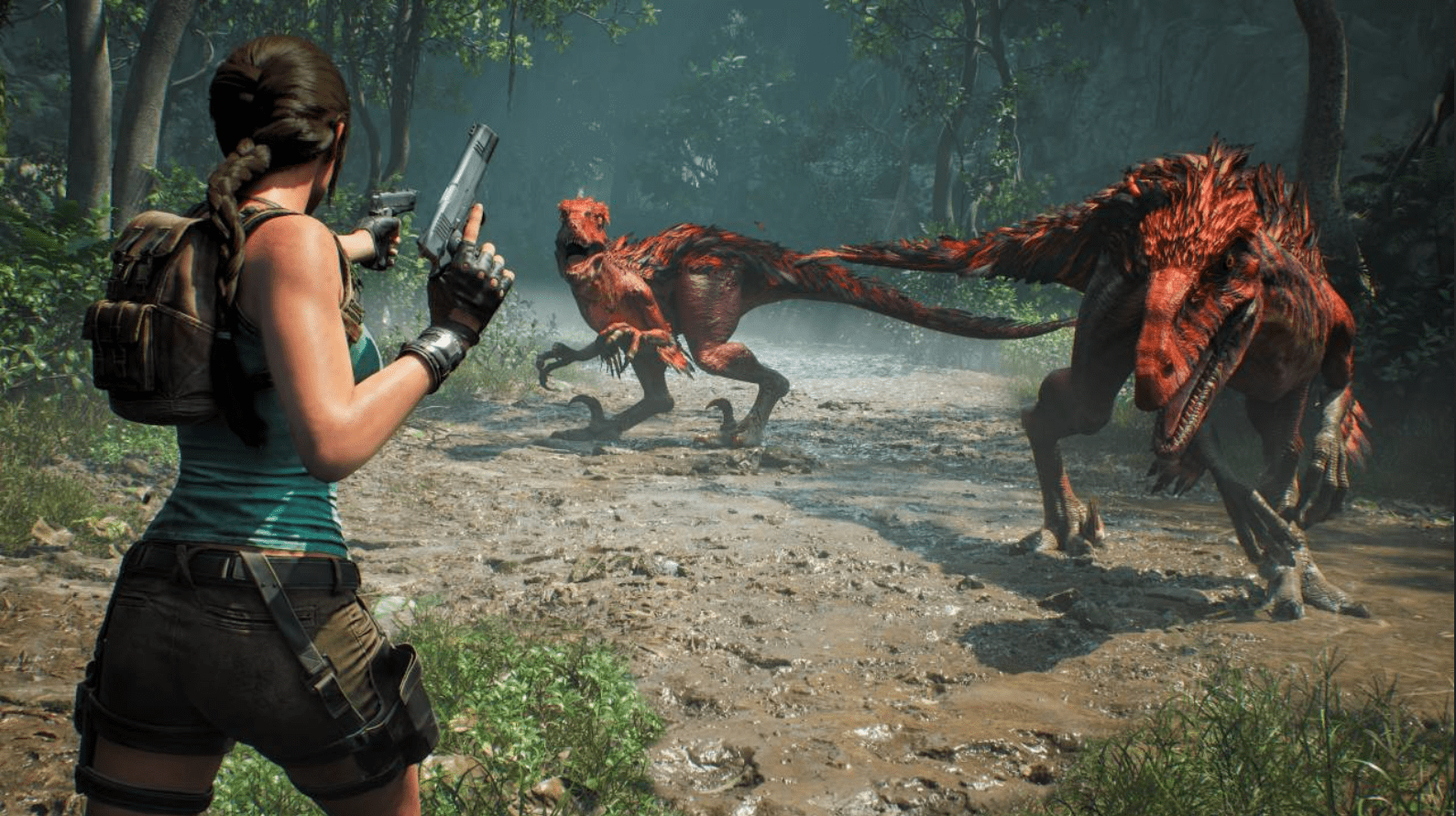
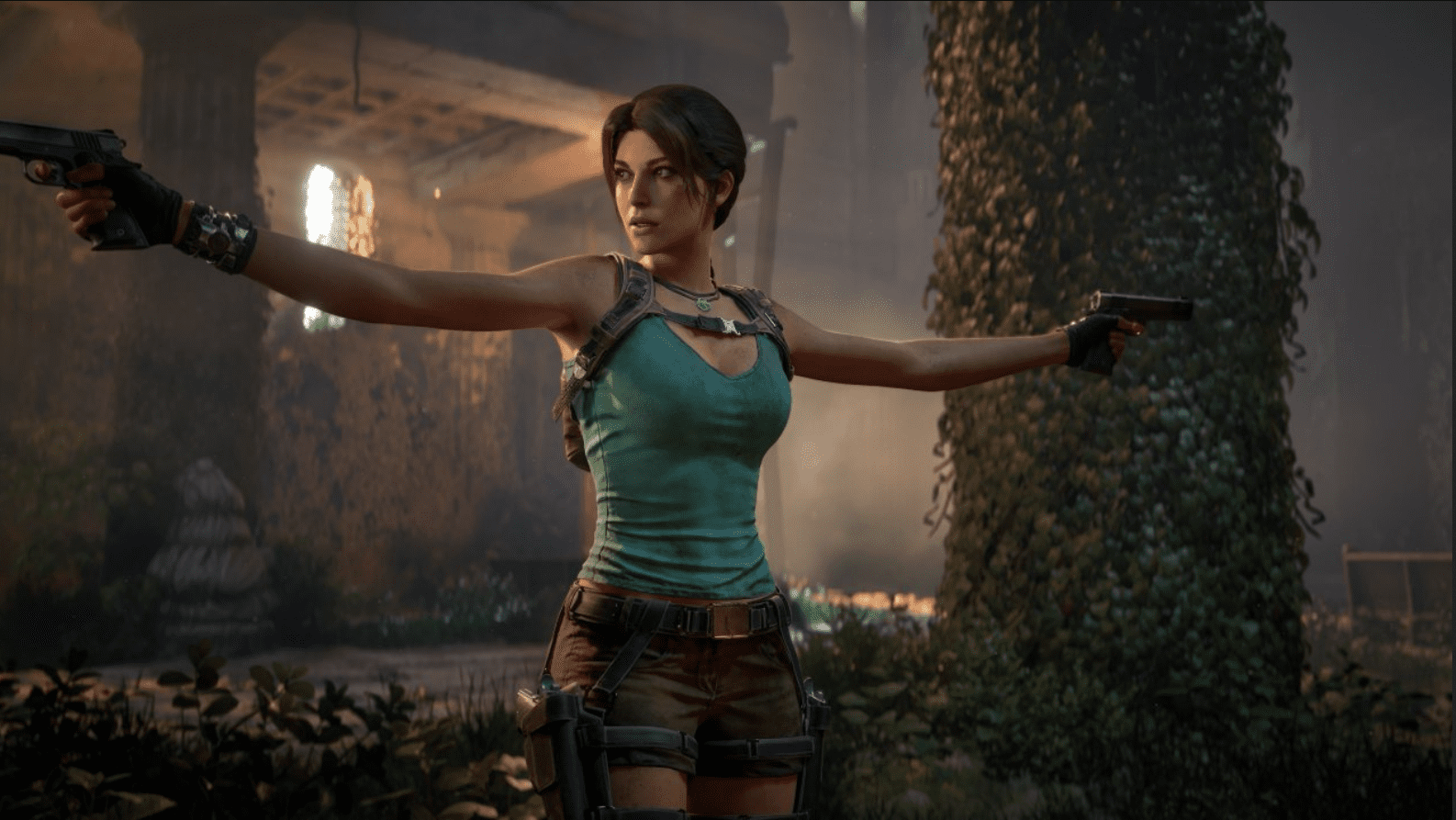
The return of her signature dual pistols is a big deal for longtime fans. These were Lara’s iconic weapons in the classic games, and seeing them back changes the tone of combat almost immediately. Instead of carefully managing limited ammo and ducking behind cover for most encounters, the dual pistols now have unlimited ammo. This pushes players toward a much more aggressive and stylish approach to fights.
Combat itself looks faster and far more acrobatic than recent Tomb Raider entries. Lara can cartwheel, dive, backflip, dodge, and fire her weapons while constantly moving. During a Velociraptor encounter shown in previews, players reportedly spent more time moving dynamically through the environment, using the terrain to their advantage, rather than crouching behind cover waiting for an opening.
This is a noticeable shift, and I think it is the right one. The earlier reboot games sometimes felt a bit too grounded and slow during combat, especially for a character who is supposed to be one of the most skilled action heroes in gaming. Bringing back that fast, almost gymnastic style of fighting feels true to who Lara Croft is.
Understanding The New Focus System
One of the more interesting additions to combat is a new focus system. As you successfully dodge attacks and perform acrobatic moves during a fight, you build up focus energy over time. Once you have enough energy stored up, you can trigger a slow motion sequence where Lara unleashes a devastating barrage of gunfire on enemies.
This mechanic feels like a natural evolution of classic Tomb Raider combat, where precise movement and timing were always important, combined with a more modern action game flair. It rewards players who play actively and take risks rather than those who just hold a position and shoot. From a semantic search perspective, this is the kind of mechanic people will be searching for under terms like Tomb Raider focus mode, Tomb Raider slow motion combat, or how to build focus in Legacy of Atlantis.
The Return Of The T Rex, Bigger Than Ever
If there is one moment that almost every longtime Tomb Raider fan was hoping to see again, it is the T Rex encounter. The original sequence from 1996 is still considered one of the most iconic moments in gaming history, and Crystal Dynamics clearly knew they had to do something special with it.
From what has been shown so far, the new T Rex encounter has been significantly expanded. Instead of just fighting a dinosaur in an open clearing like the original, players now dash frantically through dense jungle terrain while the T Rex pursues them. Slides, climbing sections, collapsing paths, narrow escapes, and cinematic chase moments all combine to create something far more dramatic than the original ever was.
At the same time, previews suggest that the encounter still keeps that same sense of awe and danger that made the original moment so memorable. This is not a complete reinvention that throws out what worked before. It is a modern reimagining that takes the bones of the original encounter and builds something bigger and more cinematic on top of it, while still keeping that gut punch feeling of suddenly realizing you are being hunted by something massive and prehistoric.
Searches like Tomb Raider Legacy of Atlantis T Rex encounter, T Rex chase sequence Tomb Raider remake, and Tomb Raider 1996 T Rex remake will likely become some of the most common queries once the game launches, simply because this moment carries so much nostalgia.
Progression, Skills, And Resource Systems
Beyond exploration and combat, previews have also hinted at a deeper progression system than the original game ever had. During the demo, players could see references to skill points, collectibles, crafting materials, and upgrade resources, although none of these systems were fully accessible yet.
This suggests that Lara’s growth throughout the game could be far more detailed than what was possible in 1996, where progression was mostly tied to finding new weapons and ammo. A modern progression system could allow players to gradually unlock new movement abilities, combat techniques, and traversal options as they explore, which would tie nicely into the open world structure and reward players for exploring thoroughly.
If you are searching for Tomb Raider Legacy of Atlantis skill tree, Tomb Raider crafting system, or Tomb Raider upgrade resources, this is an area worth keeping an eye on as more gameplay gets revealed closer to launch.
Visuals, Atmosphere, And The Power Of Unreal Engine 5
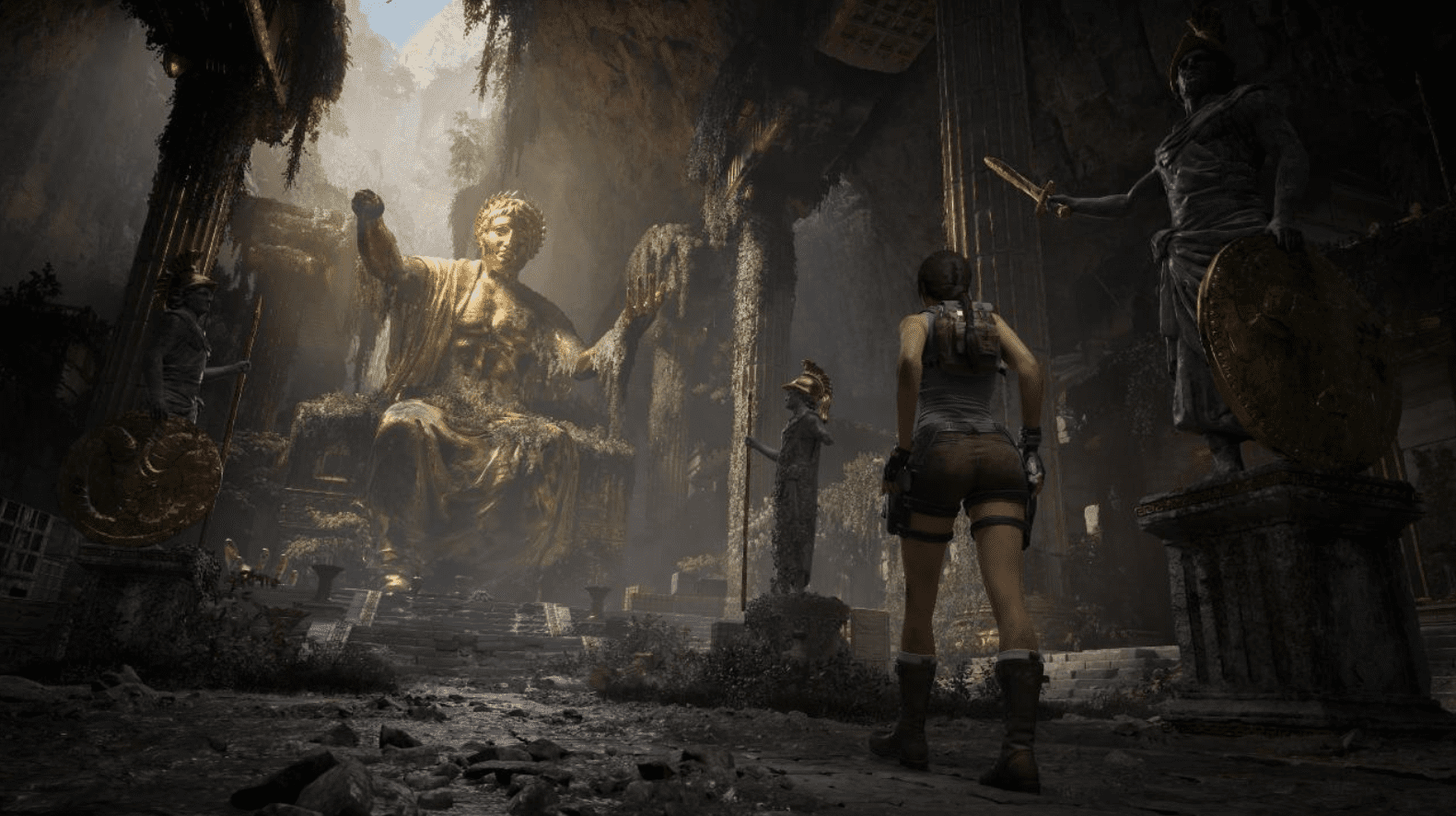
Almost every hands on report mentions the same thing when it comes to visuals: the environmental detail, lighting, and overall atmosphere are a massive step up. Built on Unreal Engine 5, the dense jungles, ancient ruins, waterfalls, hidden caves, and prehistoric creatures all look noticeably more alive than anything seen in previous Tomb Raider games.
Lighting in particular seems to play a big role in setting the mood, especially in the underground and underwater sections of the Lost Valley. Shafts of light cutting through jungle canopy, reflections in water, and the way ancient stone structures are weathered and overgrown all contribute to a sense that this world has existed for thousands of years before Lara ever set foot in it.
For players who care about visual fidelity, terms like Tomb Raider Legacy of Atlantis graphics, Tomb Raider Unreal Engine 5, and Tomb Raider Legacy of Atlantis PC requirements are likely to be popular search topics as the release date approaches.
The AI Controversy Around The Steam Page
Not everything surrounding Legacy of Atlantis has been positive. Some controversy emerged after the Steam page included language referencing generative AI technology, which understandably made some players nervous given the ongoing debates about AI in game development.
Crystal Dynamics later clarified that AI tools were only used during the early prototyping and concept visualization stages of development. According to the studio, all final assets that appear in the finished game are being created by artists using traditional development methods. Whether this explanation fully satisfies everyone is a separate conversation, and people are obviously entitled to their own opinions on the use of AI tools during development.
That said, based on the actual gameplay shown to the public so far, the result looks like the product of conventional development work rather than anything generated by AI. For most players, the focus seems to remain on what the game itself delivers in terms of gameplay and design, rather than the tools used behind the scenes during early prototyping.
Why Legacy of Atlantis Might Be The Tomb Raider Game Fans Have Been Waiting For
After going through extensive previews and watching the latest gameplay footage, I keep coming back to the same conclusion. This feels like a game made by developers who genuinely understand what made Tomb Raider special in the first place, not just from a nostalgia standpoint, but from a design standpoint too.
The combination of classic exploration, modern traversal, reworked combat, and a story that stays true to the 1996 original while expanding it for a new generation is a tough balance to strike. If Crystal Dynamics can maintain that balance across the entire game and not just the demo sections, this could end up being one of the most well rounded Tomb Raider games in the franchise’s history.
Tomb Raider Legacy of Atlantis Release Date And Editions
As confirmed during Sony’s State of Play in June 2026, Tomb Raider Legacy of Atlantis is set to release on February 12, 2027 for PlayStation 5, Xbox Series X and Series S, PC through Steam, and Nintendo Switch 2. The Japan, Asia, Australia and New Zealand release date is one day later, on February 13.
The game was originally targeted for a 2026 release, but Amazon Games and Crystal Dynamics confirmed a delay to early 2027 during the reveal. This pushes the launch just past Lara Croft’s thirtieth anniversary, since the original Tomb Raider released in October 1996.
The game is available in multiple editions. The Standard Edition is priced at 59.99 dollars, while the Deluxe Edition costs 69.99 dollars and includes two days of early access before the official launch. According to the PlayStation blog, pre orders are already live across all confirmed platforms.
Alix Wilton Regan voices Lara Croft in Legacy of Atlantis, taking over from Camilla Luddington who voiced the character throughout the Survivor trilogy. This is also the second active Tomb Raider project from Crystal Dynamics, alongside Tomb Raider Catalyst, which is an entirely new adventure also planned for 2027.
Full Controller Button Layout Guide For PC And Xbox
Based on the gameplay shown so far and the way previous Tomb Raider games have handled controls, here is a practical layout guide for both PC and Xbox controllers. Keep in mind that some of these mappings are based on standard Tomb Raider conventions combined with what has been shown in previews, and small changes are always possible before launch, but this should give you a solid idea of what to expect when you first pick up the controller.
Xbox Controller Layout
Movement and camera
Left stick controls Lara’s movement in all directions, including walking, running, and adjusting direction mid jump. Right stick controls the camera, allowing you to look around the environment and aim during combat. Clicking the right stick (R3) typically toggles between combat focus and free camera, letting you get a better view of your surroundings.
Jumping and traversal
A button is used for jumping, vaulting over obstacles, and performing context sensitive traversal actions such as grabbing ledges. B button is generally tied to crouching or rolling, which is useful for dodging incoming attacks and squeezing through tight spaces. X button is commonly mapped to interaction, used for picking up items, examining objects, and triggering environmental puzzles. Y button often handles special traversal actions such as climbing specific surfaces or activating Lara’s survival instinct mode, which highlights points of interest in the environment.
Combat controls
Right trigger (RT) fires Lara’s weapon, and with the dual pistols having unlimited ammo, this becomes a button you will be pressing constantly during fights. Left trigger (LT) is typically used for aiming, allowing for more precise shots when needed. Right bumper (RB) is often mapped to melee attacks or quick takedowns when enemies get close. Left bumper (LB) may be used for dodging or rolling out of the way during combat, working alongside the focus system to build up energy for slow motion attacks.
Grapple and special tools
Given how central the grapple is to this version of Tomb Raider, it is likely mapped to a dedicated button, possibly the D pad or a combination input alongside one of the trigger buttons. This allows quick access without interrupting movement, since you may need to swing across a gap mid jump or activate a mechanism while exploring.
Menus and miscellaneous
The View button (formerly called the back button) typically opens the map or journal, showing collected clues, objectives, and areas you have explored. The Menu button (formerly start) opens the main pause menu, where you can access inventory, settings, and the skill or upgrade system. D pad directions are often used for quick item selection, weapon switching, or accessing the focus ability once it has charged up.
PC Keyboard And Mouse Layout
Movement and camera
W, A, S, and D keys handle movement in the four basic directions, the same as most third person action games. The mouse controls the camera, allowing for smooth and precise aiming, which many players find more comfortable than a controller for combat heavy sections. Holding shift while moving usually triggers sprinting, letting Lara move faster across open areas.
Jumping and traversal
Spacebar is the standard key for jumping and vaulting over obstacles. Ctrl is commonly used for crouching or rolling, which can help during both stealth sections and combat encounters. E key typically handles interaction, used for picking up items, opening doors, and solving environmental puzzles. F key is often tied to special traversal actions or activating survival instinct mode to highlight nearby points of interest.
Combat controls
Left mouse button fires Lara’s weapon, and right mouse button is used for aiming down sights for more accurate shots. With unlimited ammo on the dual pistols, expect left click to be one of the most used inputs during combat sections. Q key is often mapped to melee attacks or quick takedowns. R key may be tied to dodging or rolling, which feeds into the focus system that allows for slow motion gunfire sequences once enough energy has been built up.
Grapple and special tools
Given the importance of the grapple in Legacy of Atlantis, expect it to be bound to a dedicated key, commonly G or a similar easy to reach key near the main movement cluster. This lets you quickly use the grapple for swinging, pulling objects, or activating mechanisms without breaking your movement flow.
Menus and miscellaneous
Tab key usually opens the map or journal screen, where you can review objectives, clues, and explored areas. Esc key opens the main pause menu, giving access to settings, inventory, and any skill or upgrade systems. Number keys 1 through 4, or similar, are often used for quick weapon switching or selecting different tools and items during exploration.
General Controller Tips For Legacy of Atlantis
One thing worth keeping in mind based on previous Tomb Raider games is that camera sensitivity settings make a big difference, especially during fast paced combat sections involving enemies like the Velociraptor or the T Rex. If you find the default sensitivity too fast or too slow, adjusting it early in the settings menu can make traversal and aiming feel much more natural.
Since the grapple appears to be tied into both exploration and combat, getting comfortable with its input early on will likely pay off throughout the game. Practicing grapple swings in safer areas before attempting more difficult traversal sections is generally a good habit in any Tomb Raider game.
For the focus system, remember that it rewards active play. Standing still and shooting from cover will build focus much slower than dodging, rolling, and moving constantly during a fight. If you are struggling with tougher combat encounters, focusing on movement first and shooting second might actually help you survive longer while also charging up your slow motion ability faster.
Frequently Asked Questions About Tomb Raider Legacy of Atlantis
When does Tomb Raider Legacy of Atlantis release?
The game is set to release on February 12, 2027 for PlayStation 5, Xbox Series X and Series S, PC, and Nintendo Switch 2, with a one day later release in Japan, Asia, Australia and New Zealand.
Is Tomb Raider Legacy of Atlantis a remake or a sequel?
It is a remake of the original 1996 Tomb Raider, rebuilt in Unreal Engine 5 with reworked gameplay systems, modern visuals, and expanded storytelling, while keeping the core story about Lara Croft’s search for the Scion.
Who is developing Tomb Raider Legacy of Atlantis?
Crystal Dynamics is leading development with help from Flying Wild Hog, and the game is being published by Amazon Games.
Does the T Rex encounter return in this version?
Yes, the T Rex encounter returns and has been significantly expanded, turning into a much longer chase sequence through dense jungle terrain rather than a single open area fight like the original.
Does Lara have unlimited ammo for her dual pistols?
Based on previews, yes. The dual pistols have unlimited ammo, which encourages a faster and more aggressive combat style compared to earlier reboot games.
Was AI used to create Tomb Raider Legacy of Atlantis?
Crystal Dynamics has clarified that AI tools were used only during early prototyping and concept stages, and that all final assets in the finished game are created by artists using traditional development methods.
What platforms is the game available on?
Tomb Raider Legacy of Atlantis is confirmed for PlayStation 5, Xbox Series X and Series S, PC through Steam, and Nintendo Switch 2.
I went into the recent previews for Tomb Raider Legacy of Atlantis expecting another generic remake, and came away genuinely excited for the first time in a while. The exploration focused design, the reworked combat with its faster pace and unlimited ammo dual pistols, the expanded T Rex sequence, and the way the game seems to respect both the classic and reboot eras all point toward something that could land really well with both longtime fans and newcomers.
There is still a long road between now and the February 2027 release date, and plenty can change between now and then. But based on everything shown so far, this feels like a Tomb Raider game built by people who genuinely care about getting it right, and that alone makes it one to keep watching closely.