
Mar 30
Warren Potter
I have spent a good amount of time with rhythm games over the years. From early flash-based browser games to full arcade setups, I know how it feels when a game just clicks. When I first heard that MUSYNX was coming back with a proper new release called MUSYNX: Return, I went straight to the Steam page and added it to my wishlist. Here is everything you need to know before it drops.
What Is MUSYNX: Return?
MUSYNX: Return is a rhythm game developed by I-Inferno and published by Wave Games. It is the follow-up to the original MUSYNX, which built a loyal community thanks to its clean interface and solid music selection. This new version strips things back to basics and focuses on giving players a pure rhythm experience without unnecessary fluff.
The original game was known for its anime-inspired tracks and mobile-friendly layout. This return build takes the same spirit but adds more polish, better audio feedback, and a cleaner visual style built around a sci-fi military theme. It is not trying to be something new for the sake of being new. It is just trying to be a great rhythm game.
The planned release window is Q1 2026 on Steam for PC. At the time of writing, the game is not yet live but is available to wishlist.
Why This Game Stands Out in 2026
The rhythm game market is crowded. You have established names like osu!, Beatmania IIDX, Cytus, Arcaea, and Muse Dash all competing for the same player base. So what makes MUSYNX: Return different?
A few things genuinely caught my attention when going through the feature list.
The Audio Feedback Is Not Generic
Most rhythm games give you the same click or tap sound regardless of which note you hit. MUSYNX: Return uses dedicated instrument sound effects tied to each note. So when you hit a note, you hear something musical rather than a dry tick. Combined with low-latency audio technology, the feedback loop between your fingers and the sound actually feels satisfying in a way that many games miss.
I have played games where the input lag ruins everything. The audio-visual sync in this title is being specifically addressed in the design, which tells me the team understands what makes or breaks a rhythm game at its core.
Three Lane Options in One Game
You get 2-lane, 4-lane, and 6-lane modes. That is not just cosmetic. Each lane count changes how the game plays completely. Two-lane is great for newcomers or quick sessions. Four-lane is the sweet spot for most players. Six-lane pushes you into territory that requires genuine focus and coordination.
Having all three in a single game means you are not locked into one difficulty curve. You can start simple and grow into the harder formats without needing a different game for each stage of your skill development.
35 Songs at Launch with More Coming Free
The game launches with 35 original tracks. Within the first six months after release, at least 25 additional songs will be added through free DLC. That is a solid commitment from the developer. It means you are not paying for a small slice and then constantly paying for more content. The post-launch roadmap is included in the base purchase.
All audio content in the game was created without AI. Some visual assets used AI generation, which the developer has openly disclosed. That transparency is something I respect, especially right now when a lot of studios are quietly using AI without telling anyone.
Full Feature Breakdown
Classic Falling Note Gameplay
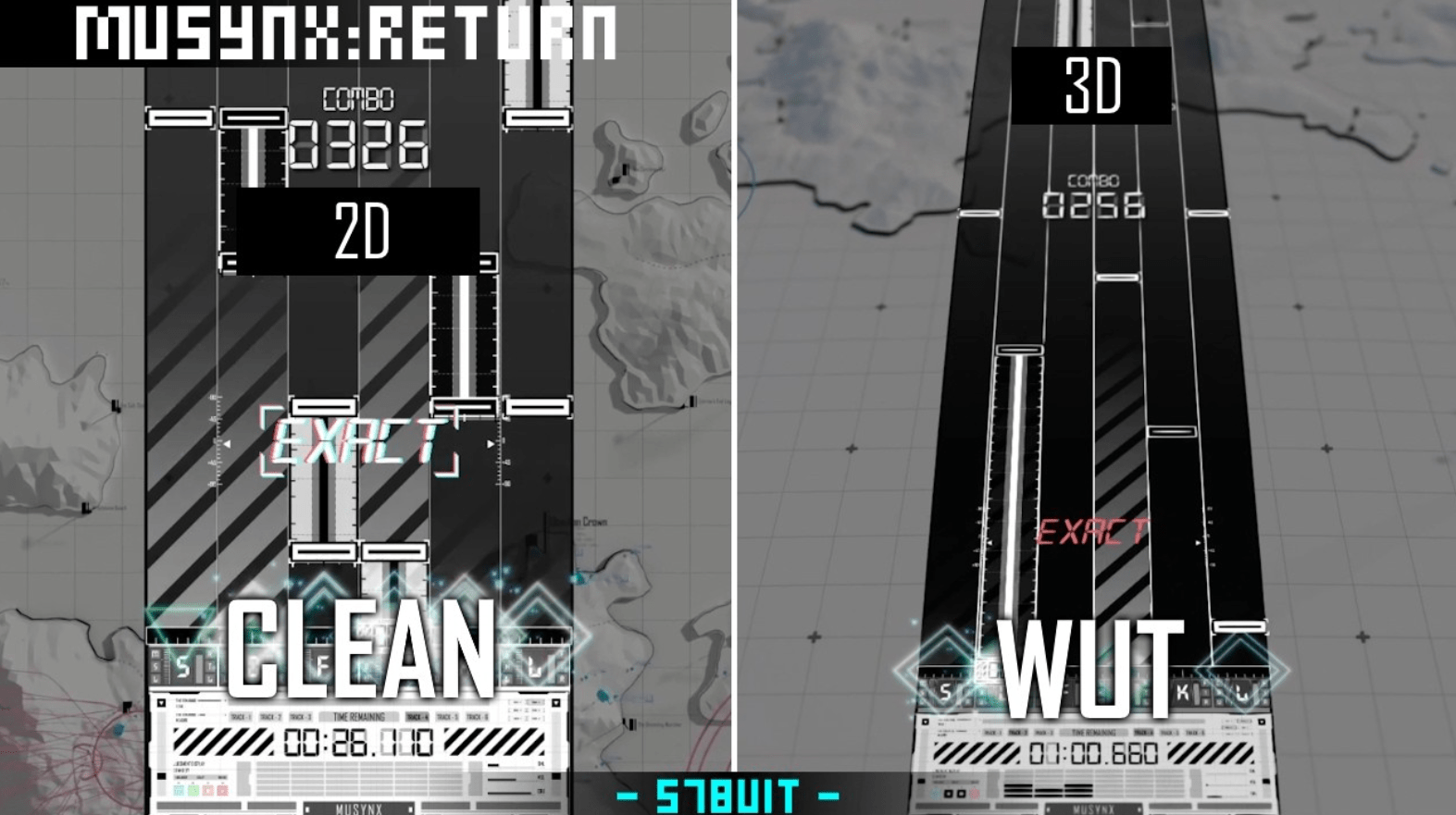
The game uses traditional falling-note mechanics. Notes come from the top of the screen and you hit them as they reach the judgment line. This format is familiar to anyone who has played games in this genre. MUSYNX: Return keeps this format clean and readable with a clear interface that does not get in the way during fast sections.
2-Lane Mode for Beginners
The 2-lane mode is specifically designed for people who are new to rhythm games. You only need two fingers and the charts are simple enough to learn on. This is a good entry point. I have watched friends who never play rhythm games pick up similar modes and actually enjoy themselves within minutes. That accessibility matters.
9 Difficulty Variations Per Track
Every track in the game has nine difficulty options. That comes from combining three lane types (2-key, 4-key, 6-key) with three difficulty levels each. So even on the same song, you have multiple ways to challenge yourself depending on your current skill level.
This system is genuinely well thought out. It keeps long-term players engaged because they can keep pushing into harder charts on songs they already know. It also means the game has a very long shelf life without needing new content to stay interesting.
Performance Statistics and Timing Feedback
The game includes a professional accuracy indicator and detailed result screen. You can adjust the timing offset to match your setup, which is important if you are playing on a monitor with any input delay or using a sound system that introduces latency. The result screen breaks down your performance so you can see exactly where you are losing points and what to work on.
For competitive or score-focused players, this kind of data is essential. Casual players can ignore it entirely and still have a good time.
Fast Load Times
The developers claim you can go from launching the game to playing a song in as fast as 10 seconds. That might sound like a small detail but it changes how you actually use the game. When you only have 15 minutes to play, a slow menu system eats into your time. Quick access means you actually play more.
4K Visuals
The art style is built around a sci-fi military aesthetic. It is clean, sharp, and different from the typical anime-cute visuals you see in a lot of rhythm games. Whether you prefer that style is personal, but the commitment to 4K support means it looks genuinely good on a high-resolution display.
MUSYNX: Return System Requirements
The game is designed to run on older hardware as well, which makes it accessible to a wide range of players.
Minimum Requirements
- OS: Windows 7, 8, 10, or 11
- Processor: Intel Core i3-2100 or AMD equivalent
- RAM: 4 MB (this is listed as 4 MB in the current spec sheet, though this likely reflects an early listing and may update closer to launch)
- Graphics: Intel HD Graphics 3000
- DirectX: Version 9.0
- Storage: 6 GB available space
- Sound Card: DirectX compatible
Note: Steam itself only supports Windows 10 and later as of January 2024, so while the game lists Windows 7 and 8 compatibility, you will need Windows 10 or 11 to actually run it through Steam.
These requirements are very low, which means the game will run on almost any modern PC or laptop without issue. A gaming rig is not required.
How to Download MUSYNX: Return on PC
The game is coming to Steam. Here is the full process to get it once it releases.
Step 1: Create or Log Into Your Steam Account
Go to store.steampowered.com and sign in. If you do not have an account, create one for free. Steam is the only confirmed platform for this game at launch.
Step 2: Search for MUSYNX Return
Use the search bar at the top of the Steam store. Type MUSYNX and the game should appear. You can also browse directly through the developer page for I-Inferno or the publisher Wave Games.
Step 3: Add to Wishlist Before Launch
Since the game is not yet available, add it to your wishlist now. Steam will send you an email notification the moment it goes live for purchase. This is the simplest way to not miss the release.
Step 4: Purchase and Install
Once released, click the green Buy button on the store page, complete the purchase through Steam’s checkout, and then click Install from your Steam library. The game is 6 GB so download time depends on your internet speed.
Step 5: Launch and Play
After installation, hit Play from your Steam library. The game promises a 10-second path from launch to gameplay. Select your song, choose your lane mode and difficulty, and start playing.
Full PC Controller Button Layout Guide
MUSYNX: Return supports keyboard and controller input on PC. Here is a complete breakdown of how controls work across both input types.
Keyboard Layout (PC Default)
Most rhythm game veterans on PC use the keyboard. The default layout for each mode is designed to feel natural for both index-finger and full-hand play styles.
2-Lane Mode (Keyboard)
| Lane | Default Key | Alternative Key |
|---|---|---|
| Lane 1 (Left) | F | Z |
| Lane 2 (Right) | J | / (slash) |
4-Lane Mode (Keyboard)
| Lane | Default Key | Alternative Key |
|---|---|---|
| Lane 1 | D | Z |
| Lane 2 | F | X |
| Lane 3 | J | . |
| Lane 4 | K | / |
6-Lane Mode (Keyboard)
| Lane | Default Key | Alternative Key |
|---|---|---|
| Lane 1 | S | A |
| Lane 2 | D | S |
| Lane 3 | F | D |
| Lane 4 | J | K |
| Lane 5 | K | L |
| Lane 6 | L | ; |
Menu and System Keys (Keyboard)
| Action | Key |
|---|---|
| Confirm / Select | Enter |
| Back / Cancel | Escape |
| Navigate Up | Up Arrow or W |
| Navigate Down | Down Arrow or S |
| Pause Game | Escape or P |
| Retry Song | R (from result screen) |
| Return to Song Select | Escape (from result screen) |
Xbox Controller Layout (PC and Xbox)
For players who prefer a controller or are playing on an Xbox-compatible device, the controller layout maps rhythm inputs to face buttons and triggers. This is not the fastest input method for hard charts, but it works well for casual and intermediate play.
2-Lane Mode (Xbox Controller)
| Lane | Button |
|---|---|
| Lane 1 (Left) | X Button or Left Bumper (LB) |
| Lane 2 (Right) | B Button or Right Bumper (RB) |
4-Lane Mode (Xbox Controller)
| Lane | Button | Notes |
|---|---|---|
| Lane 1 | Left Bumper (LB) | Far left |
| Lane 2 | X Button | Inner left |
| Lane 3 | B Button | Inner right |
| Lane 4 | Right Bumper (RB) | Far right |
6-Lane Mode (Xbox Controller)
| Lane | Button | Notes |
|---|---|---|
| Lane 1 | Left Trigger (LT) | Far left outer |
| Lane 2 | Left Bumper (LB) | Left inner |
| Lane 3 | X Button | Center left |
| Lane 4 | B Button | Center right |
| Lane 5 | Right Bumper (RB) | Right inner |
| Lane 6 | Right Trigger (RT) | Far right outer |
Menu and System Controls (Xbox Controller)
| Action | Button |
|---|---|
| Confirm / Select | A Button |
| Back / Cancel | B Button |
| Navigate Menu | D-Pad or Left Stick |
| Pause Game | Start / Menu Button |
| Retry | Y Button (from result screen) |
| Return to Song Select | B Button (from result screen) |
| Scroll Song List | Left Stick Up or Down |
| Change Lane Mode | Left or Right on D-Pad |
| Change Difficulty | LB or RB in song select |
Tips for Controller Players
If you are coming from keyboard rhythm games, switching to a controller takes adjustment. The most important thing is to use your index fingers on the bumpers and your thumbs on the face buttons. For 6-lane mode, rest your index fingers on the bumpers and use your middle fingers on the triggers. Your thumbs handle the face buttons.
Start on 2-lane mode with a controller if you are new. Build the muscle memory on your left and right sides before adding more lanes. Moving to 4-lane and then 6-lane will feel much more natural once you have that foundation.
If the default button mapping does not feel right, check the settings menu for remapping options. Most modern rhythm games allow custom key binding and MUSYNX: Return is expected to support this as well.
Song List and Music Library at Launch
The game ships with 35 original tracks. All music in MUSYNX: Return is original content, not licensed songs from outside artists. The developer I-Inferno has worked with composers to produce tracks across different music styles, staying consistent with the sci-fi military visual theme.
While the full track list has not been officially published yet, the game has been confirmed to include:
- Electronic and synth-heavy tracks suited for fast-paced charts
- Mid-tempo tracks designed for 4-lane introductory charts
- High-BPM tracks built for 6-lane expert players
- A range of moods from intense to ambient, giving the library some variety
After launch, 25 or more songs will be added as free DLC over the first six months. These will be delivered as automatic updates. You do not need to pay anything extra to receive them.
Difficulty System Explained
Understanding the difficulty system helps you get the most out of the game from day one. Each song has nine total charts. Three lane modes multiplied by three difficulty levels gives you that number.
Difficulty Levels Per Lane Mode
- Easy: Low note density, simple patterns, great for learning the song
- Normal: Moderate density, introduces more complex rhythms and cross-lane patterns
- Hard: High density, fast streams, requires consistent accuracy and good hand coordination
Recommended Path for New Players
Start on 2-lane Easy. Once you can clear songs without missing too many notes, move to 2-lane Normal. After that, jump to 4-lane Easy. This progression keeps the challenge manageable while teaching you the patterns you will need for harder content.
Do not skip straight to 6-lane on your first session. The jump in complexity is significant and learning bad habits early can slow your progress. Take it step by step and you will improve faster.
Timing System and Accuracy Indicators
The game uses a standard accuracy judgment system with multiple tiers. While the exact labels may vary from what other games use, the typical setup in games like this includes:
- Perfect: Hit right on the beat, maximum score
- Great: Slightly early or late, reduced score
- Good: Off timing but still counted as a hit
- Miss: Did not register as a hit
MUSYNX: Return includes an adjustable timing offset in the settings. If your monitor or audio setup introduces lag, you can dial in the offset to compensate. Getting this calibrated correctly is one of the most important setup steps for rhythm games. Even a few milliseconds of offset can affect your accuracy score significantly.
The result screen shows your accuracy breakdown, max combo, score, and grade. Use this information after each play to understand where you are losing points.
Visual Design and What to Expect
The game uses a sci-fi military theme. This is a shift from the typical anime or casual art style common in the rhythm genre. The design feels more serious and polished, with dark backgrounds, sharp geometry, and mechanical visual elements.
4K resolution support means the game looks excellent on a high-resolution monitor. The note highway and interface are designed to be readable even during fast sections, which matters a lot when you are trying to process information quickly.
Some visual assets in the game were created using AI generation tools. The developer has disclosed this directly, which is the right approach. The audio, including all 35 launch tracks and the instrument note sounds, was created entirely by humans.
Who Is This Game For?
MUSYNX: Return works for a wide range of players. If you are new to rhythm games, the 2-lane mode and easy difficulty give you a real entry point that does not feel condescending. If you are experienced, the 6-lane hard charts and accuracy system give you something to genuinely compete against.
The quick launch time and clean interface make it good for short sessions. You do not need to commit 30 minutes to get value from it. Five minutes between other tasks can still be a satisfying play session.
The original MUSYNX had a dedicated community. People who enjoyed that game will feel at home here quickly. The core feel is preserved while the production quality has gone up.
Comparing MUSYNX Return to Similar Games
It is worth understanding where MUSYNX: Return sits alongside other games in the same space.
MUSYNX Return vs Muse Dash
Muse Dash uses a side-scrolling format with two lanes and an emphasis on cute character art. MUSYNX: Return uses a vertical falling-note format with up to six lanes and a sci-fi aesthetic. They share the rhythm genre but the actual gameplay feel is quite different. Muse Dash is more casual. MUSYNX: Return scales further in difficulty.
MUSYNX Return vs osu!
osu! is free and built around community-made charts for existing songs. MUSYNX: Return uses original music and developer-created charts. osu! has a much larger content library because of its community, but MUSYNX: Return has more consistent quality control and a more structured difficulty system.
MUSYNX Return vs Beatmania IIDX
IIDX is the original 7-lane vertical note game and is considered the benchmark for serious rhythm players. MUSYNX: Return uses up to 6 lanes with a lower skill ceiling entry point. IIDX is more complex and harder to get into. MUSYNX: Return is more accessible without sacrificing depth at the higher levels.
Developer and Publisher Background
The game is developed by I-Inferno and published by Wave Games. I-Inferno developed the original MUSYNX, which launched on mobile and PC and gained a solid following. The decision to build MUSYNX: Return as a return to core gameplay principles suggests the team listened to community feedback about what made the first game work.
Wave Games has been involved in publishing indie rhythm and arcade titles. Their involvement on the publishing side means MUSYNX: Return gets proper store presence and update support, which matters for a game that is planning ongoing free content updates.
For official updates from the developer, the Steam store page shows update logs. The latest update listed was from December 31, 2025, suggesting active development was still happening into the final stretch before launch.
Supported Languages
The game supports the following languages for its interface and audio:
- English: Full interface and audio support
- Simplified Chinese: Full interface and audio support
- Japanese: Interface only
- Traditional Chinese: Interface only
- Korean: Interface only
Subtitles are available for English and Simplified Chinese. For players in Japan, Taiwan, and Korea, the game is fully navigable in your language even without full audio localization.
External Resources Worth Checking
- Steam Store for the official game page and wishlist
- PCGamingWiki for technical fix guides after launch
- Reddit r/rhythmgames for community discussion and tips
- Gamepad Tester to verify your controller is detected before launching the game
My Personal Take on MUSYNX: Return
I have a bias toward rhythm games that respect the player’s time. Games that take five minutes just to navigate the menu lose me fast. MUSYNX: Return’s commitment to fast load times and direct gameplay access is something I care about genuinely, not just as a feature on a spec sheet.
The instrument sound feedback is the thing I am most curious about. I have played games that tried this and got it wrong, making the audio feedback feel disconnected from the music. If I-Inferno has actually pulled this off, it changes the feel of playing in a meaningful way. I will be testing this on day one and updating thoughts based on what I find in practice.
The free DLC model is also a point of trust. Developers who say they will add content for free after launch sometimes do not follow through. The fact that it is documented on the Steam page gives players some baseline expectation they can hold the team to.
Overall, this is a rhythm game I am genuinely looking forward to. Not because of marketing, but because the feature set addresses real things that matter in the genre.
Frequently Asked Questions About MUSYNX: Return
When does MUSYNX Return release on Steam?
The game is scheduled for Q1 2026. A specific date has not been confirmed at the time of this writing. Add it to your Steam wishlist to get a notification when it goes live.
Is MUSYNX Return free to play?
No. MUSYNX: Return is a paid game on Steam. However, post-launch content including at least 25 songs added over the first six months will be delivered as free DLC at no additional cost.
Does MUSYNX Return work on Mac or Linux?
The current system requirements list Windows only. There is no confirmed Mac or Linux version at this time.
Can I play MUSYNX Return with a controller?
Yes. The game supports Xbox controller input on PC. The full button layout for both PC keyboard and Xbox controller across all three lane modes is covered in the controller guide section above.
What is the storage size for MUSYNX Return?
The game requires 6 GB of available storage space. Make sure you have that free before downloading.
How many songs does MUSYNX Return have?
It launches with 35 original tracks. At least 25 more will be added as free DLC within the first six months after release.
Is MUSYNX Return good for beginners?
Yes. The 2-lane mode with easy difficulty is specifically designed for people who have never played a rhythm game before. You can learn the basics with just two fingers before moving into more complex lane setups.
Does MUSYNX Return use AI-generated music?
No. All audio content in the game was created by humans without AI. Some visual assets were made using AI generation, which the developer has clearly disclosed on the Steam page.
What is the difference between MUSYNX and MUSYNX Return?
MUSYNX was the original indie rhythm game by I-Inferno. MUSYNX: Return is the new follow-up, built from the ground up with improved visuals, new lane modes, instrument sound feedback, and a sci-fi military art style. It is not an update to the original. It is a new game with the same core design philosophy.
Can I adjust timing offset in MUSYNX Return?
Yes. The game includes adjustable timing feedback so you can compensate for display lag or audio latency on your specific setup. This is important for getting accurate judgment results.
Is there an Xbox console version of MUSYNX Return?
The confirmed platform at launch is PC via Steam. An Xbox console release has not been announced. Controller input using an Xbox controller on PC is supported.
What PC specs do I need for MUSYNX Return?
The minimum requirements are very low. An Intel Core i3-2100, 4 MB RAM, Intel HD Graphics 3000, DirectX 9.0, and 6 GB of storage will run the game. Almost any PC made in the last ten years will meet these requirements.
Where can I follow updates for MUSYNX Return?
The Steam store page for MUSYNX: Return is the best place for official updates. The developer I-Inferno published the most recent update log on December 31, 2025. Adding the game to your wishlist will also notify you of major announcements.
Download Links
If you are facing any issue in downloading or need assistance Click here .