
0
0
Mar 30
Warren Potter
I have been watching the indie game space closely for the past few years, and every now and then something quietly shows up on Steam that makes me stop scrolling. Yokai Art 2: Tales of the Nine-Tails did exactly that. It is not a big-budget release. It does not have a massive marketing campaign behind it. But the combination of hex-based tactical combat, Chinese and Japanese folklore, and an actual story-driven progression loop gave me enough reason to dig deep into everything that is publicly known about it – and write it all down here.
This is a complete breakdown. By the time you finish reading, you will know the story, the gameplay systems, how to play it on PC and Xbox with a controller, what your computer needs to run it, and what to realistically expect when it launches.
What Is Yokai Art 2: Tales of the Nine-Tails?
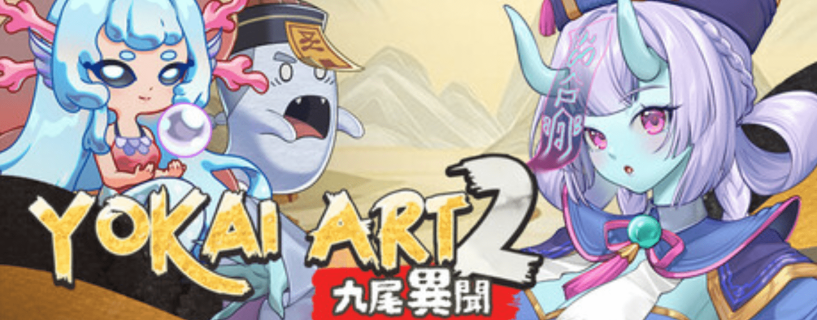
Yokai Art 2 is the direct follow-up to the original Yokai Art, developed and published by Secret Labo in partnership with Reborn Entertainment and Tora Creatives. The game sits at an interesting crossroads of genres. On the surface it looks like a tower defense game. Get deeper into it and you find roguelite progression, RPG ability upgrades, and a narrative that pulls from two of Asia’s richest mythological traditions.
The planned release window is Q1 2026 on Steam. At the time of writing, no exact date has been confirmed, but the Steam page is live and accepting wishlists. There are zero user reviews yet, which means this article is one of the earliest detailed breakdowns available anywhere.
Languages supported at launch: English, Japanese, Korean, Russian, and Simplified Chinese – all with full interface and audio options. That multilingual support already tells you the developers are targeting an international audience, which makes sense given how deeply the game draws from both Chinese and Japanese culture.
The Story – Where Yokai Art 2 Picks Up
If you played the first game, you know Hiro and his companions spent a significant amount of time fighting the storm gods Fujin and Raijin. That conflict is over. The sequel opens with a rare moment of rest. Hiro is back at his grandfather’s house in Japan, and for a brief time, things feel normal.
That peace breaks the moment Sanbi senses something in the distance. A call. A pull she cannot explain. Sanbi is a three-tailed fox spirit who has traveled with Hiro, but what the game now reveals is that Sanbi is not a complete being on her own. She is a fragment – a separated piece of a much larger and more powerful entity: the nine-tailed fox, one of the most iconic mythological creatures in East Asian folklore.
The source of the summon turns out to be Sanbi’s true body, currently located somewhere in China. This discovery forces the group to make a decision fast. Hiro, Sanbi, and their companion Yoshiko pack up and head to what the game calls The Land of Dragons – a China-inspired setting filled with creatures from Chinese mythology alongside the Japanese yokai players already know from the first game.
I find this story setup genuinely interesting because it does something smart. It uses the mystery of Sanbi’s identity as the emotional engine of the sequel rather than just throwing a bigger villain at the player. You are not racing to stop an apocalypse in the first hour. You are trying to figure out what Sanbi actually is and what her nine-tailed form means for the journey ahead.
Gameplay Systems Explained in Full – The Hex Map = Navigation and Node Types
The biggest structural change from the first game is the move to a hex-based map for overworld navigation. Instead of a linear path or an open world, you move across a grid of hexagonal nodes. Each node is a choice.
Some nodes hold battles. Some contain treasure chests. Others trigger scenario events story moments, dialogue scenes, or encounters that do not involve direct combat but affect your run. This system is similar in spirit to what you find in games like Slay the Spire or Dungeon Encounters, but built around a hex grid rather than a card-based path.
The hex design is not just aesthetic. It forces you to think about which path you take between nodes. Two routes to the same boss might look equal on the map, but one could give you more treasure while the other lines up more battles for unit XP. That kind of spatial decision-making adds a strategy layer before any actual combat even starts.
Unit Placement – Chessboard Battlefield
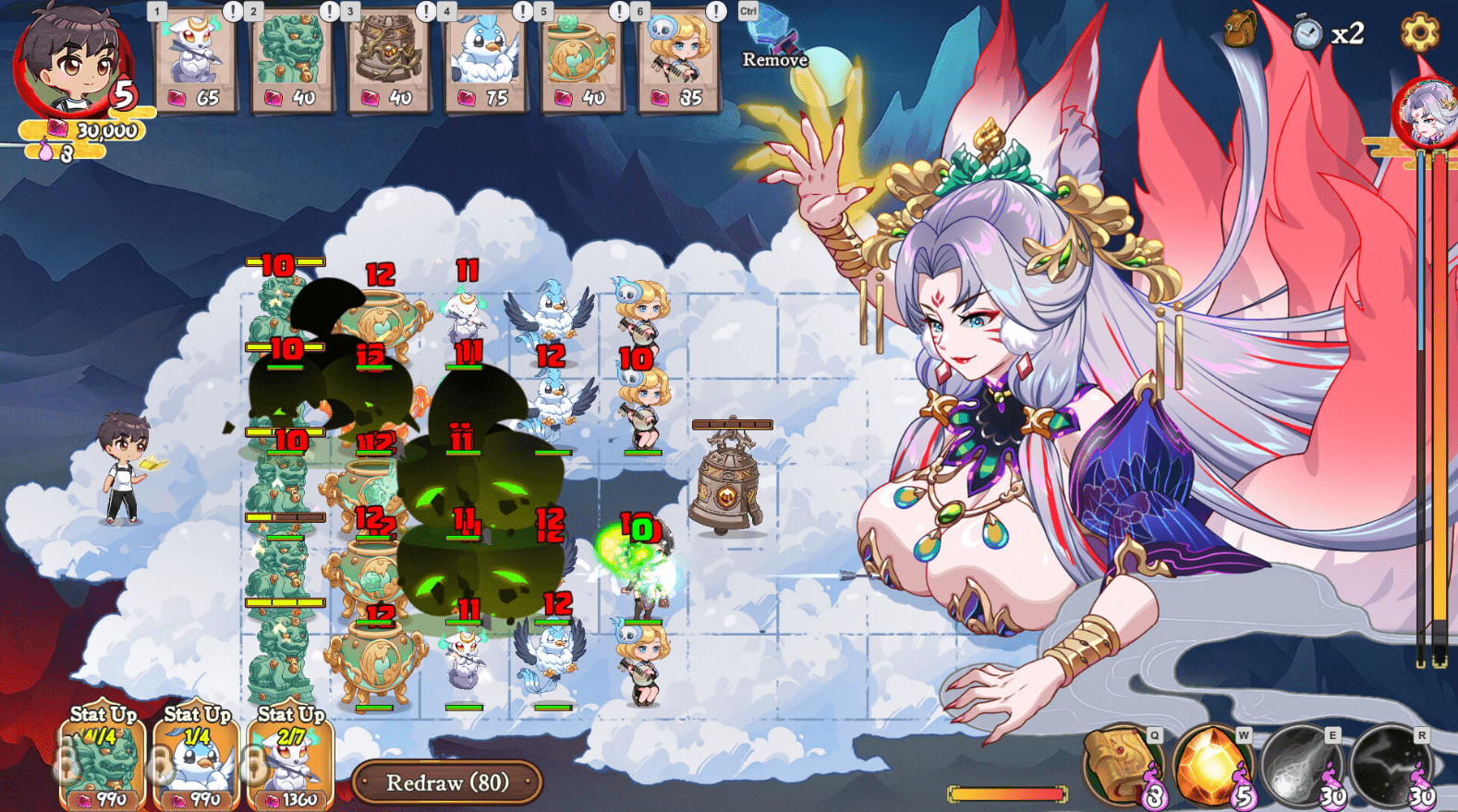
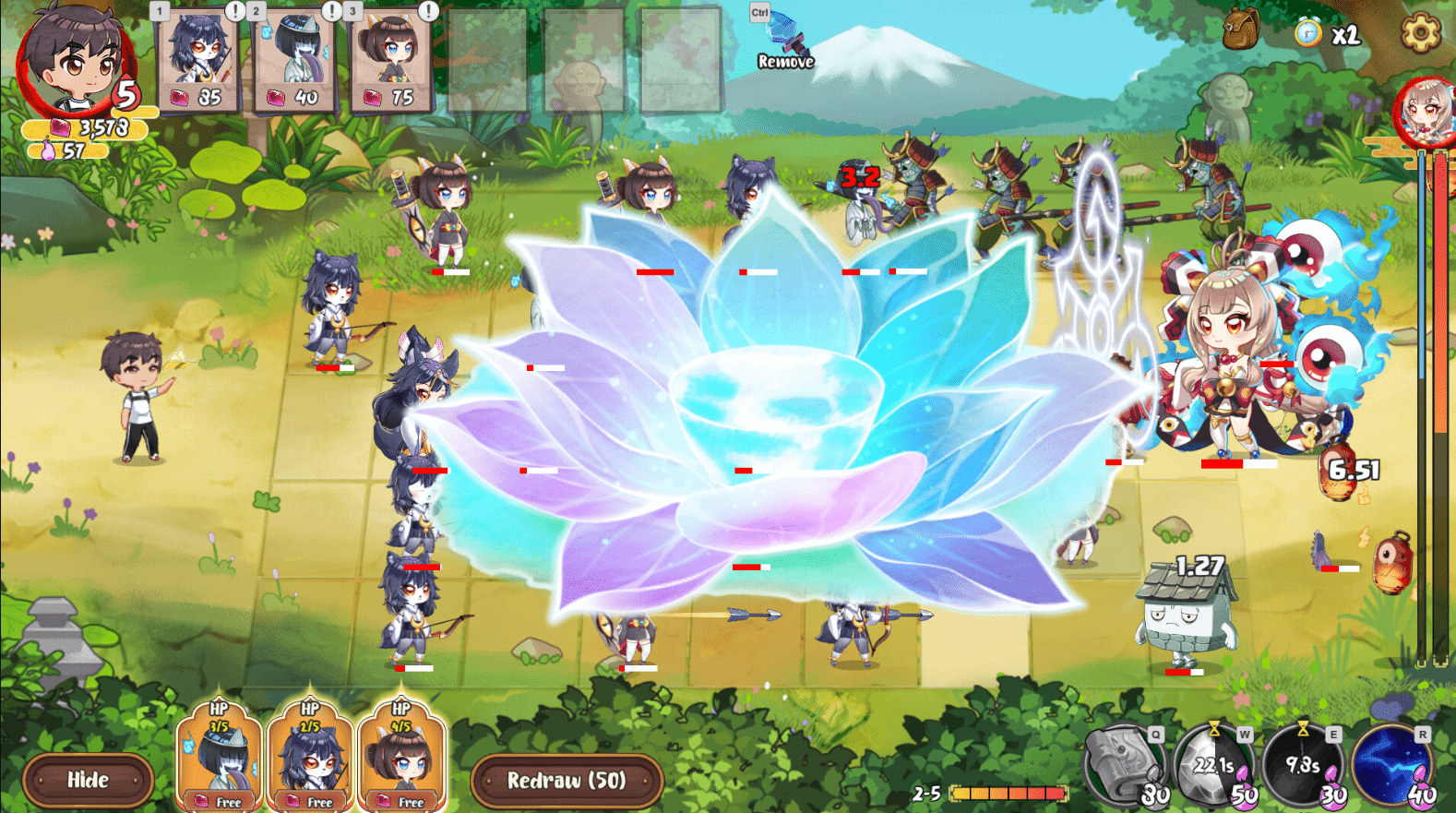
Combat in Yokai Art 2 takes place on a chessboard-style grid. You place your units on this grid before waves of enemies arrive, and positioning matters more than raw power. A unit in the wrong spot might have zero effect on the enemy path. The same unit placed one square over could cover three lanes at once.
The game mixes real-time tactics with tower defense. Enemies move toward your position in waves, and you need to think about both where to place units and when to use their active skills. This is not a passive “set and forget” tower defense. Units have abilities that you trigger manually, and knowing when to use them changes outcomes significantly.
Roguelite Progression – Runs, Upgrades, and Powerstones
Each run through the game adds to Hiro’s permanent ability set. When a run ends – whether through completion or failure – you come back with progress. Upgrades to Hiro carry over, which means each attempt at a section gets slightly more manageable as your base stats and skill options grow.
Two core systems drive unit power:
- God’s Boons and Relics – Passive items collected during a run that stack and compound. Some relics affect all units. Some are specific to a character. Building a relic combination that works together is one of the deeper optimization paths in the game.
- Powerstones – These are the evolution mechanic. Collecting enough Powerstones for a unit triggers a transformation into their ultimate form. In their evolved state, units deal more damage, have enhanced skill effects, and access new attack animations. This is the equivalent of a class upgrade in traditional RPGs, but handled through item collection rather than leveling.
The relic and boon system is where most of the replayability lives. Two players can reach the same boss with completely different relic builds and have entirely different experiences fighting it. That kind of variance is what keeps roguelite games fresh across multiple runs.
Spiritual Energy and Enemies
Defeating enemies drops spiritual energy, which feeds directly into unit power. The stronger the enemy, the more energy it releases. This creates a risk-reward loop in the hex map – you can take the harder combat nodes to farm more energy, but harder fights come with greater risk of losing units or failing the run.
Elite enemies and boss encounters are described as requiring advance planning. The developers have stated each boss has distinct behavior patterns and combat styles. You cannot brute-force them. You need to understand how they move, when they are vulnerable, and which units counter their strengths.
Also Read
Call Of Duty Warzone Season 4 New June 12 Update Live Patch Notes PC PS4 Xbox One Full Details Here
Call Of Duty Warzone Season 4 New June 12 Update Live Patch Notes PC PS4 Xbox One Full Details Here
The Mythology – Chinese and Japanese Folklore Combined
This is one of the areas I find most compelling about Yokai Art 2. Most games pick one culture’s mythology and run with it. This one deliberately blends two.
Japanese yokai mythology is the foundation from the first game. Creatures like kitsune (fox spirits), oni, and tengu are established parts of the world. The nine-tailed fox specifically comes from East Asian mythology shared across Japan, China, and Korea – each culture has its own version of the creature, with different names and slightly different attributes.
In Japanese tradition, the kitsune gains a new tail for every century of life and growing wisdom. A nine-tailed kitsune is therefore ancient and immensely powerful. In Chinese folklore, the equivalent creature is the húlí jīng, which carries a more complex reputation – sometimes benevolent, sometimes a trickster, sometimes outright dangerous. The game setting in China for this sequel opens up the húlí jīng interpretation of Sanbi’s true form, which adds narrative tension. Is her nine-tailed form benevolent or dangerous? The story is built around answering that.
For players who want to go deeper into the source material, Britannica’s entry on the kitsune and the broader Metropolitan Museum of Art’s resources on Japanese mythology are worth reading before or after playing.
Full Controller Button Layout Guide – PC and Xbox
Yokai Art 2 supports controller input on PC. Since the game has not released yet, the layout below is based on standard genre conventions for hex-map tower defense games and what the developers have shown in promotional material. I will update this guide post-launch when the full button mapping is confirmed.
Xbox Controller Layout for Yokai Art 2 (PC and Xbox)
| Button / Input | PC Function | Xbox Function |
|---|---|---|
| Left Stick | Move cursor across hex map / battlefield | Move cursor across hex map / battlefield |
| Right Stick | Rotate or pan camera view | Rotate or pan camera view |
| A Button | Confirm / Select node or unit | Confirm / Select node or unit |
| B Button | Cancel / Back / Deselect unit | Cancel / Back / Deselect unit |
| X Button | Use active unit skill / ability | Use active unit skill / ability |
| Y Button | Open unit info / relic details | Open unit info / relic details |
| LB (Left Bumper) | Cycle left through units | Cycle left through units |
| RB (Right Bumper) | Cycle right through units | Cycle right through units |
| LT (Left Trigger) | Hold to see enemy path preview | Hold to see enemy path preview |
| RT (Right Trigger) | Activate Powerstone evolution (when available) | Activate Powerstone evolution (when available) |
| D-Pad Up | Open upgrade / boon menu | Open upgrade / boon menu |
| D-Pad Down | Toggle spiritual energy display | Toggle spiritual energy display |
| D-Pad Left | Previous relic in collection | Previous relic in collection |
| D-Pad Right | Next relic in collection | Next relic in collection |
| Start / Menu | Pause / Open main menu | Pause / Open main menu |
| Back / View | Map overview / Run summary | Map overview / Run summary |
| Left Stick Click (L3) | Center camera on active unit | Center camera on active unit |
| Right Stick Click (R3) | Reset camera to default position | Reset camera to default position |
PC Keyboard and Mouse Layout
| Key / Input | Function |
|---|---|
| WASD or Arrow Keys | Move cursor on hex map and battlefield |
| Left Mouse Click | Select hex node, place unit, confirm action |
| Right Mouse Click | Cancel selection / deselect unit |
| Mouse Scroll Wheel | Zoom in and out on battlefield |
| Middle Mouse Button | Pan camera across the map |
| Q | Use active skill for selected unit |
| E | Open unit details and relic list |
| R | Activate Powerstone evolution |
| Tab | Cycle through placed units |
| Space | Start wave / Confirm ready |
| Escape | Pause menu / Back |
| M | Open full map view |
| 1, 2, 3, 4 | Quick-select units by slot number |
| F | Toggle fast-forward during enemy wave |
| G | View God’s Boon / relic overview |
Tips for Playing with a Controller
Hex grid navigation with a controller takes about 20 to 30 minutes to feel natural. The cursor snapping between hexes can feel slightly slow at first compared to a mouse, but most hex-based games let you hold the stick in a direction to move faster. Use LB and RB to tab between units instead of manually moving the cursor back across the field each time. This saves significant time during waves when you need to trigger skills quickly.
For Powerstone evolutions, the RT trigger activation requires a brief hold rather than a tap in most games of this genre. This is intentional – it prevents accidental activation when you want to save the evolution for a harder wave. Get used to the hold timing early.
On PC without a controller, the F key fast-forward is your best friend. Once your unit placement is locked in and the wave is moving predictably, hitting fast-forward lets you see the outcome without watching every second of it in real time.
System Requirements – What You Need to Run It
Minimum Requirements
- Operating System: Windows 10 or higher (64-bit required)
- Processor: Intel Core i3 or AMD Ryzen 3
- RAM: 6 GB
- Graphics: Any GPU with 512 MB VRAM or more
- DirectX: Version 11
- Storage: 5 GB available space
Recommended Requirements
- Operating System: Windows 10 or higher (64-bit required)
- Processor: Intel Core i3 or AMD Ryzen 3
- RAM: 8 GB
- DirectX: Version 11
- Storage: 10 GB available space
The minimum and recommended specs are very close. The main difference is RAM – 6 GB minimum versus 8 GB recommended. The 10 GB storage recommendation versus the 5 GB minimum suggests the game installs optional high-resolution assets separately, or that patches and DLC are factored into the recommended storage figure.
These are light requirements by 2026 standards. Any PC built in the last five or six years should handle this without issue. The Intel Core i3 baseline tells you the game is not computationally demanding, which makes sense for a 2D hex strategy game. The 512 MB VRAM minimum is extremely accessible – even integrated graphics on modern CPUs can meet or exceed that.
If you are playing on a budget PC or an older laptop, the minimum specs are genuinely achievable rather than artificially lowered for marketing purposes.
AI-Generated Art – Transparency From the Developers
Secret Labo disclosed on the Steam page that some icon and background art in the game started as AI-generated images before being manually refined by artists. This is worth discussing honestly rather than glossing over.
The use of AI in game art is a genuine debate in the industry right now. The developers chose transparency, which I respect. They did not claim the art is entirely hand-drawn, and they specified that human artists did finish and refine the AI-generated base work. That process is meaningfully different from simply dropping raw AI output into a product.
For players who care about this: the game does contain some AI-assisted art. For players who prioritize gameplay systems and story over the origin of background assets: the art quality in the trailers looks consistent with the game’s aesthetic direction.
If you want a broader understanding of where the industry stands on this issue, Game Developer Magazine has covered AI in game development extensively and is worth reading for context.
Mature Content – What to Expect
The game carries a mature content warning. The developers state that players can unlock characters wearing revealing outfits in suggestive poses with corresponding voice acting. This content is locked behind in-game progression rather than appearing by default.
This is a common feature in Japanese-developed games and is clearly disclosed upfront. The Steam page tags include “Sexual Content” as a user-defined label. If that is not content you want in the game, it is worth knowing before purchase. If it does not affect your decision, the disclosure at least ensures there are no surprises.
What Makes This Game Worth Watching
Honestly, several things stand out to me about Yokai Art 2 that make me confident it deserves more attention than it is currently getting.
First, the genre blend is done with intention. Hex-map roguelite progression combined with chessboard tower defense is not a random mashup. Both systems reward the same skill – spatial thinking. How you route across the hex map affects what resources you arrive at combat with. How you position on the battlefield determines whether those resources translate into a win. The two systems talk to each other.
Second, the mythology choice is specific. A lot of games use “Asian mythology” as a broad aesthetic. Yokai Art 2 is working with identifiable creatures – Fujin and Raijin from the first game, the nine-tailed fox in this one – and building actual story logic around them. Sanbi being a fragment of her true nine-tailed body is not just flavor. It is the core question the whole game is built around answering.
Third, the roguelite structure means the content has genuine replay value. Once the story is complete, build variety through relic combinations and Powerstone evolutions keeps runs feeling different. That is the promise of the genre done well.
Fourth, and this is practical: the system requirements are accessible. A strategy game that can run on a machine with 6 GB RAM and a budget GPU is a game that more people can actually play.
How to Add Yokai Art 2 to Your Steam Wishlist
The game is live on Steam and accepting wishlists right now. Adding it to your wishlist does two things: it gets you a notification the moment it launches, and it signals to the developers that there is interest in the game. For a small indie studio like Secret Labo, wishlist numbers directly affect how much Steam promotes the game at launch.
To wishlist: visit the Steam store page, click the green wishlist button under the release date notice, and you are done. You do not need to pay anything or create any additional accounts.
Steam also has a complete breakdown of how wishlists work if you want to understand how the algorithm factors them into launch visibility.
Comparing Yokai Art 2 to Similar Games
If you have played any of the following games and enjoyed them, Yokai Art 2 is likely in your wheelhouse.
Dungeon Defenders – The chessboard unit placement and wave defense structure is directly comparable. Yokai Art 2 adds the roguelite hex map layer on top.
Voice of Cards – Not mechanically similar, but the approach of building a JRPG-adjacent story around mythological creatures with strong visual art style is a comparable creative decision.
Fights in Tight Spaces – The grid-based tactical positioning in that game rewards the same spatial planning that Yokai Art 2’s battlefield requires.
Loop Hero – The roguelite loop of building up power across runs before tackling harder content mirrors what Hiro’s persistent upgrade system offers.
Yokai Art 2 is not a clone of any of these. But if you have a history with the genre, the systems will feel immediately readable.
Developer and Publisher Background
Secret Labo is a smaller studio, and Yokai Art 2 is one of their higher-profile releases. Reborn Entertainment and Tora Creatives are listed as co-publishers, suggesting a distribution partnership rather than a full production co-development. The multilingual release with Japanese audio support alongside English and Korean indicates the game was built for an international audience from the start rather than localized after the fact.
The studio’s decision to disclose the AI art use and the mature content description upfront shows a level of consumer transparency that is not universal in the indie space. That matters when deciding whether to trust a studio with a purchase.
Also Read
Call of Duty Modern Warfare New June 12 Update Live Patch Notes PC PS4 Xbox One Full Details Here
Call of Duty Modern Warfare New June 12 Update Live Patch Notes PC PS4 Xbox One Full Details Here
Frequently Asked Questions
What type of game is Yokai Art 2: Tales of the Nine-Tails?
It is a hybrid of hex-map roguelite navigation and chessboard tower defense combat. You move across a hex grid choosing between battles, treasure nodes, and story events, then defend against enemy waves by placing units on a grid-based battlefield. Hiro gains permanent upgrades between runs, giving the game a roguelite progression feel.
When does Yokai Art 2 come out?
The planned release window is Q1 2026 on Steam. No specific date has been announced at the time of writing. Adding the game to your Steam wishlist will send you an automatic notification the moment a date is confirmed or the game goes live.
Who is developing Yokai Art 2?
The game is developed by Secret Labo and published jointly by Secret Labo, Reborn Entertainment, and Tora Creatives.
What languages does Yokai Art 2 support?
The game launches with English, Japanese, Korean, Russian, and Simplified Chinese. All five languages include full interface and audio support. Japanese also includes subtitles.
Does Yokai Art 2 have a story or is it purely gameplay?
It has both. The story follows Hiro, Sanbi, and Yoshiko traveling to China to find the source of a mysterious summon connected to Sanbi’s true nine-tailed form. Scenario nodes on the hex map deliver story content between combat encounters. It is not a purely mechanical game.
What is the Powerstone system in Yokai Art 2?
Powerstones are collectibles that evolve your units into more powerful ultimate forms. When a unit reaches their evolved state, they gain enhanced stats, new skill effects, and stronger attack patterns. This is the main unit advancement system alongside the relic and boon collection.
Can I play Yokai Art 2 on Xbox?
The game is announced for PC via Steam. Xbox availability has not been confirmed as of the current information. The game does support Xbox controllers on PC, and the button layout guide in this article covers that configuration fully.
Does Yokai Art 2 have controller support on PC?
Yes. The game supports controller input on PC. The full Xbox controller layout is covered in the guide above, including hex map navigation, unit placement, skill activation, and Powerstone evolution inputs.
What are the system requirements for Yokai Art 2?
The minimum specs are Windows 10 (64-bit), an Intel Core i3 or AMD Ryzen 3, 6 GB RAM, a GPU with at least 512 MB VRAM, DirectX 11, and 5 GB of free storage. Recommended specs upgrade RAM to 8 GB and storage to 10 GB. Most mid-range and even budget PCs from the last several years can run this.
Does Yokai Art 2 use AI-generated art?
Yes, partially. The developers disclosed that some icon and background art was initially generated by AI before being manually refined by human artists. The disclosure is part of the official Steam page for the game.
Is there mature content in Yokai Art 2?
Yes. Players can unlock characters in revealing outfits with suggestive poses and voice acting. This content is optional and locked behind in-game progression. The mature content description is disclosed on the Steam store page.
What mythological creatures appear in Yokai Art 2?
The game features creatures from both Japanese yokai mythology and Chinese folklore. Confirmed characters include Sanbi (a three-tailed fox spirit / fragment of the nine-tailed fox), Fujin and Raijin (Japanese storm gods from the first game), and a range of Chinese mythological enemies in the Land of Dragons setting. Both kitsune traditions and Chinese húlí jīng interpretations of the nine-tailed fox are relevant to the story.
How does the hex map work in Yokai Art 2?
The hex map is the overworld navigation system. You move between hexagonal nodes, each of which contains a different type of encounter – combat, treasure, or story event. The path you choose across the map affects what resources, relics, and spiritual energy you collect before reaching boss encounters. Planning your route is part of the strategy.
What is God’s Boon in Yokai Art 2?
God’s Boons are passive buffs collected during a run. They stack with relics to create compound effects across your team. Choosing which boons to prioritize based on your current unit composition is one of the deeper strategic layers of the game.
How does the roguelite system work in Yokai Art 2?
Hiro gains permanent ability upgrades after each run. Whether you complete a section or fail, some progression carries forward. This means each attempt at a difficult section becomes more manageable as your base power increases over time. Unit-specific upgrades happen within a run through relics, boons, and Powerstones.
Download Links
If you are facing any issue in downloading or need assistance Click here .